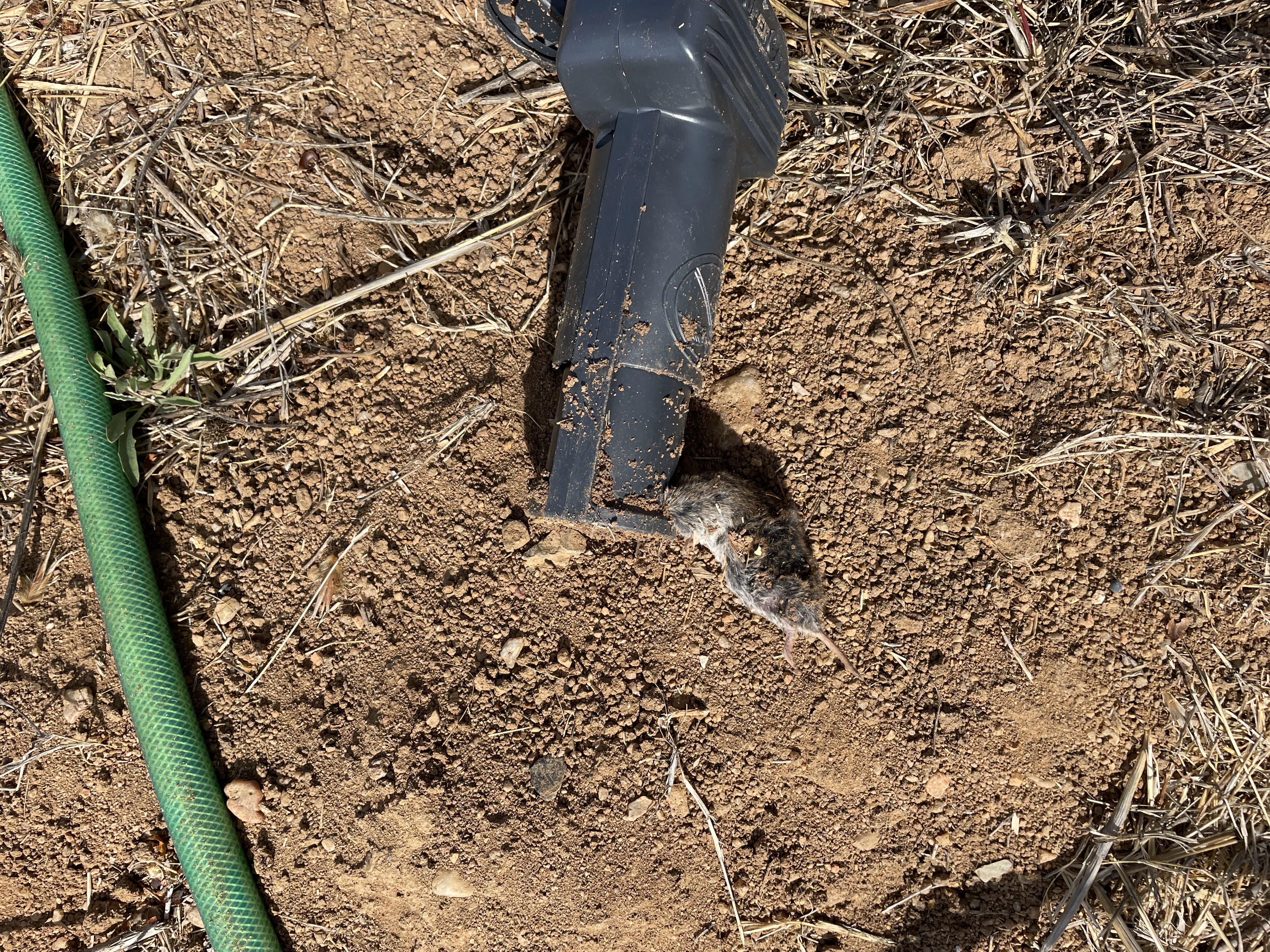
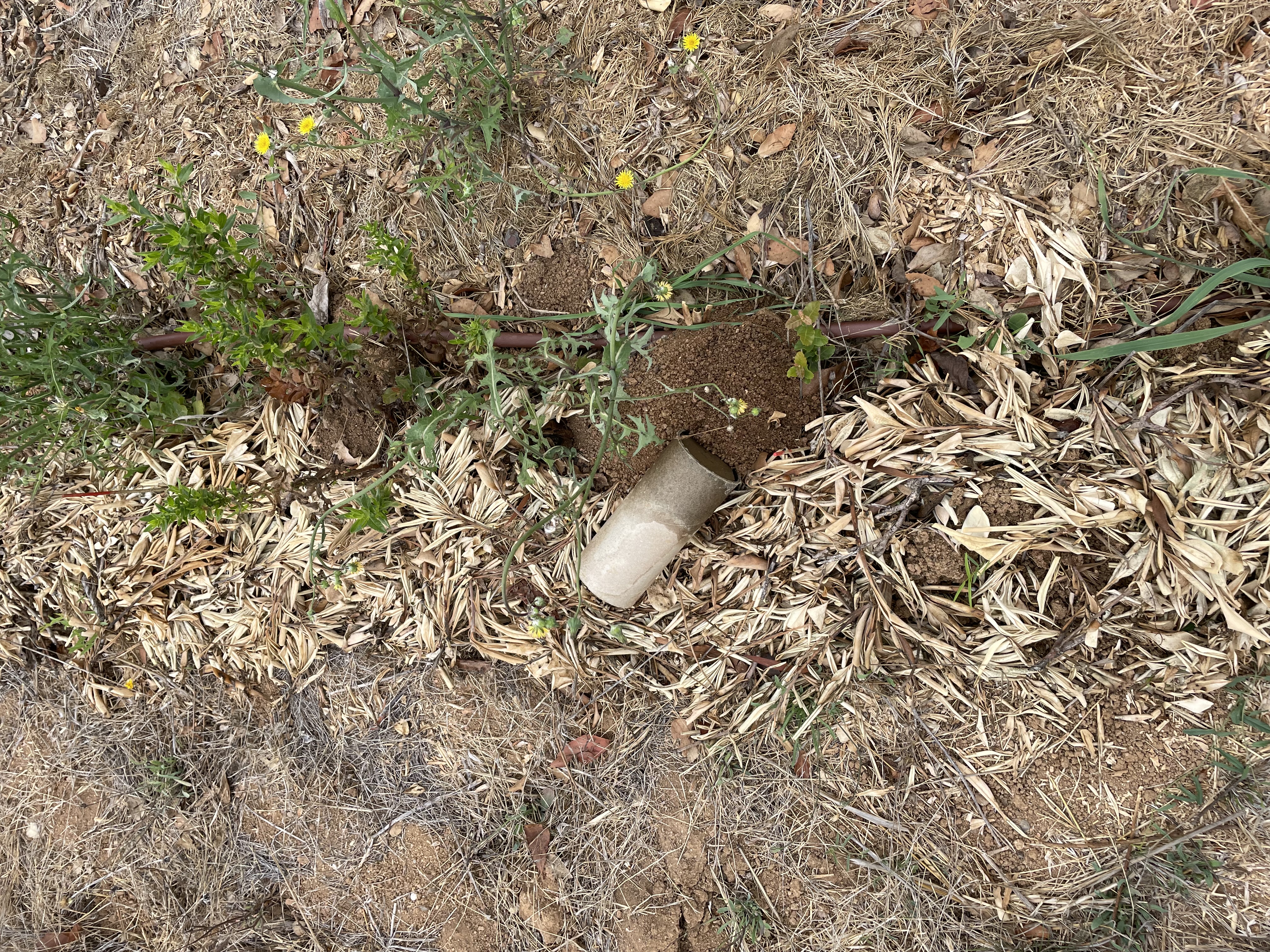
The word boredom does not exist in our Azoia diary as a new challenge presented itself: The vole. A vole is not a mole. The mole feasts on critters and makes a solid pile right above its burrows. The vole takes us by the scruff of the neck by depositing its piles somewhere next to the tunnel and enthusiastically feeds on the acorns which were sown with so much love and care by our friends! Day after day we see the oak saplings that have sprung up with fervor slowly shrivel up because their sturdy taproot has been consumed by these long teethed buggers.
We understand that many farmers face the same problem. Of course, the drought will play a role, which makes our lines with drip irrigation especially interesting.
Moreover, there is a delicious layer of mulch on both sides of those same lines. What more could a mouse want to hide and make love? Because reproduction definitely is the motto. Voles have no shame.
Moreover, our land is infested with the tubers of the sorrel (Oxalis) and this is also high on their menu.
Standing still for very long with a shovel at the ready proved too much of a strain on our arm muscles so we opted for other remedies. Here is a list for your learning and amusement:
- Solar-powered devices that give a high “PEEP” at irregular intervals.
- Cardboard tubes containing (obviously ecological) oasis soaked in a liquid called Topuleum obtained from Rail Infrabeheer. We learn that Dutch railway embankments also suffer from an overpopulation of voles. The tubes give off a burning smell in the wind but dry out too quickly in the brisk Azoia wind to be effective.
- Human hair in the tunnels. This proved impractical: the corridors collapse on the attempt (we thank Siça our hairdresser for making this experiment possible).
- Digging in beer bottles so the wind whistles them away.
- Karbit, a small lump of something that, once wetted, creates a small cloud of gas which does not kill the tunnel dwellers but definitely makes their lives unpleasant.
- Ricinus, a plant we have in our system as support for the small trees, the mice seem to avoid.
- Gijs plants 3 tall poles with beautiful perching branches for birds of prey and Ellie constructs snake villas from stones and branch material in different places.
- He also goes on the attack with mouse traps. He literally can’t turn his butt around, that’s how fast the trap is sometimes filled. Unfortunately, they also often remain empty.
- And to top it all off, we buy three 30-liter containers that we slowly fill with our and our visitor’s urine diluted with crushed garlic and onions. After a nice fermentation in the Portuguese sun we pour it out with the ladle around every oak tree still standing.
It’s hard to tell if and how well everything worked, we can tell though that attacking on multiple fronts did pay off as we still have a reasonable number of lovely little oak trees standing tall.
By now, beginning of November, the vole activity has greatly decreased but we but we hold our hearts for next year as the lovely rain of the last few weeks has also caused the Oxalis to reawaken explosively which makes sense: this land has been tilted and compacted for so long, it takes longer than a mere year to restore a
certain balance.